 |  |  |
 | Reviews for Decalog 3: Consequences |
|
| | |
There is 1 review so far. To add a review of your own for this item, visit the voting page.
| By: | David Layton, Los Angeles, United States |
|
| Date: | Monday 26 October 2026 |
|
| Rating: |   7 |
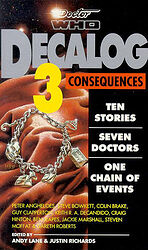
The third of the Decalog series of anthologies has a new editing team, but follows the main idea of the previous two collections. The stories have a loose thread connecting each, but none is dependent upon the others. This collection is "famous" for featuring Steven Moffat's first published work in Doctor Who. The stories in this collection are mostly middling. A few are entertaining, none is outstanding, and one is close to awful. All that perhaps makes this collection slightly more worth reading than the previous two. The thread holding together the series is that what The Doctor does has consequences elsewhere. And of course, since this is time-traveling Doctor Who, the consequences can happen before the causal events. Thus, each story works from a "consequence" created in the previous story.
The set opens with the awful story. Stephen Bowkett's ham-fisted writing style and lack of control with plotting make this story very hard to read. Strangely, the following story is the best of the series. It's a story sans Doctor (but with fake Doctor) involving Sarah Jane and K-9. Peter Anghelides does an excellent job of holding together the pieces of a story about virtual reality and memory told asynchronously. From there, the other low point stories are Guy Clapperton's "Tarnished Image," which feels like one of those middle of the season sitcom episodes where, to save money, the characters hang around one set and reminisce about previous episodes. Jackie Marshall's "Past Reckoning" is another entry in "it's all the Doctor's fault," and even has the Doctor just skip out and leave the consequences for someone else. Keith R.A. DeCandido provides the third true clunker, a Brigadier and Doctor 4 story with plotholes and improbabilities (I'm talking story logic improbablities, not the type used to drive fantasy plots) in abundance. The second story truly worth reading, though, is Steven Moffat's "Continuity Errors," which uses the concept of The Doctor going back in time to tinker with the personal history of a person who, because of obstinacy born from personal tragedy, is preventing The Doctor from saving lives. Moffat, of course, uses this idea again, but in an entirely different plot, in the 11th Doctor special "A Christmas Carol."
As a final assessment, I say that the great weakness is in the choice of writers, most of whom are fan fiction writers. Thus, the writing most of the time never rises above fan-fiction quality. Awkward wording, telegraphed details, "fun" ideas that really would never work for a fully developed story, nods and winks to fans all over the place, these are, sadly, the norm rather than the exception. Only Anghelides and Moffat rise above this level of writing and achieve a professional-quality work.