There are 2 reviews so far. To add a review of your own for this item, visit the voting page.
| By: | Don Machin, Sydney |
|
| Date: | Monday 10 May 2004 |
|
| Rating: |   8 |
I found this an interesting book, especially as I have been reading the Virgin NAs somewhat piecemeal. It struck me as a good attempt to show the sort of character the TV Doctor is (and perhaps was going to be if you remember the last series) as well as show how he has changed as a person and in his dealings with his companions. It also tries to show the impacts on companions past & present.

| By: | David Layton, Los Angeles, United States |
|
| Date: | Thursday 1 January 2026 |
|
| Rating: |   7 |
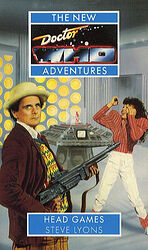
It took Steve Lyons some time to find his footing as a novelist. I have read several of his books for the BBC line, and they were in my estimation all excellent, among the best Doctor Who original novels available. I have been much less impressed by the novels he wrote for the Virgin line. I am speculating that this has much to do with the different editorial policies of the publishers. The Virgin line has pursued a path with the series that I have largely detested. They chose to exaggerate the "manipulative" Seventh Doctor, to turn all the companions into badass warriors, and to reconfigure Doctor Who as Space Opera Mission: Impossible. The subtleties that made Doctor Who work have been abandoned. Instead, to inject some kind of interest other than thud-and-blunder, the Virgin novels have squabbling among the TARDIS crew, one of whom has to, around every 50 or so pages, tell themselves how much they hate The Doctor. Head Games steps in as a potential critique of this narrative line. It works as the New Adventures version of Trial of a Timelord, including multiple references to that particular series. To this end, Lyons has written a novel to bring back old Doctor 7 companions - Mel, Ace, and Brigadier Bambera - and connect them with the new ones. The result is that there are about four stories going on at once, intersecting at various points, none of which is fleshed out quite enough.
The job of interrogating the New Adventures line is down to Mel, the moral center of the novel. She sees the new Doctor 7 and does not at all like what she sees. He tries to mount some justification for his behavior, with vague remarks about his "mission" and being "Time's Champion." Ace and Benny in a small way back him up. However, these do not really counter the points that Mel makes. Basically, try as he might to justify the line taken in the New Adventures, Lyons fails to do this adequately, in the same way that Trial of a Time Lord failed to do so for Doctor 6. I found myself agreeing with all of Mel's critiques, which are not just against The Doctor as the NAs have portrayed him, but against the entire conception of Doctor Who that the NAs have put together. In essence, it ain't Doctor Who. What has been substituted is "Doctor Who," the alternate version created by the immature mind of Jason (read the novel for relevant details). I suspect that maybe Lyons ultimately agrees with Mel, too. He tries very hard, because he has a contract to fulfill and editorial policies to meet. He just cannot make the New Adventures feel like a reasonable development from the prior series. Thus, I found reading Head Games a highly frustrating endeavor. I really wanted it to be the novel that set the series back on its true course. Instead, the novel ends up with the flaws that have dogged all the NA series: a dubious Doctor, companions squabbling, simplistic action movie antics, "science" that makes no sense, a poorly conceived alien society, and an ending of runaway chaos and violence.
