 |  |  |
 | Reviews for Christmas on a Rational Planet |
|
| | |
There is 1 review so far. To add a review of your own for this item, visit the voting page.
| By: | David Layton, Los Angeles, United States |
|
| Date: | Tuesday 6 October 2026 |
|
| Rating: |   6 |
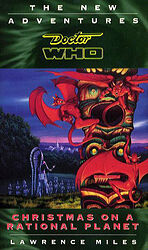
Lawrence Miles ends up being another writer whose works readers either love or hate. Christmas on a Rational Planet seems to be designed to produce that result. I do not hate this novel, but I did have to force my way through it. I found that the payoff was not worth the effort. Basically, this is a "look how much I can screw around with reality" kind of book. It does not have a plot as such. The driving idea appears to be a notion that the universe is some kind of battle ground between the Eternal Feminine - Cacophony, and the Eternal Masculine - Reason. Thus, the first strike against the novel for me is this ham-fisted gender essentialism. The second strike is Miles' lack of coherent plotting. His notion for what drives a novel is to concoct some threatening situation and have characters escape from it, but nothing fully links one threatening scenario to another. It is as if Miles thinks that constant action, any action, just getting the characters moving, is enough to make the reader ignore the lack of coherence, never to notice that the "plot" is held together with celo tape and paper clips. The third strike is a typical first or early novel error - too many elements. The book reads as if Miles had five half-formed ideas for novels and decided just to cram them all into one. Thus, there's a secret French society devoted to hunting Time Lords, some stuff about latent psychic abilities, yet another reality-warping Time Lord device gone rogue (actually two of them - the amaranth and Interface), some commentary on slavery, some stuff about the fragility of history surrounding a nascent USA, ancient and terrible demigods duking it out, etc. The fourth is all the reality warping. There's too much of it. Miles treats it as his easy trick for avoiding thoughtful examination of reality. The fifth strike is another first or early novel mistake - razzle dazzle stylistics. Miles wants to impress, and so uses layers of internal monologue, disjunctive passages, quick cutting between scenes, snappy dialogue, and so on. These show-off techniques get in the way of telling the story. The sixth strike is an abundance of anachronisms, especially in the dialogue. If you can't write historically accurate dialogue, then don't set your novel in that part of history.
Really, it's a sad case of a novel with much potential thwarted by the writer's ambition and the editor's unwillingness to check it.